
AML training is often treated as a requirement to complete rather than a capability to build. That distinction matters.
For financial institutions, fintechs, investment firms, and other regulated businesses, an effective AML training course should do more than explain definitions. It should help professionals understand financial crime risks, apply regulatory requirements, follow internal controls, and make sound decisions within their roles.
In the UAE, the Central Bank of the UAE (CBUAE) states that AML/CFT/CPF training should be ongoing and risk-based, with training tailored to employees’ responsibilities and their exposure to money laundering, terrorist financing, and proliferation financing risks (Central Bank of the UAE [CBUAE], 2025a).
So, what should effective AML training actually cover?
Why Does AML Training Matter in Financial Services?

Money laundering and related financial crime risks do not sit within one department. They can affect customer onboarding, payments, transactions, risk assessment, compliance monitoring, and senior management oversight.
This is why AML compliance training should connect regulatory requirements with the work employees perform every day.
AML Training Is More Than a Compliance Requirement
Completing a course does not, by itself, demonstrate that an employee can apply AML requirements effectively.
Professionals may need to identify unusual activity, understand customer risk, follow escalation procedures, maintain appropriate records, and apply internal policies. Training should therefore help employees understand not only what the rules require, but also how those requirements relate to their responsibilities.
The CBUAE’s current guidance describes AML/CFT/CPF training as an important part of an institution’s overall compliance programme and calls for ongoing training, including updates to regulations, policies, procedures, and emerging risks (CBUAE, 2025a).
Who Should Receive AML Training?
AML training can apply across the organisation.
This may include new employees, front-line teams, compliance professionals, risk functions, senior management, board members, and staff involved in independent testing. The level and focus of training should reflect each person’s responsibilities and exposure to money laundering, terrorist financing, and proliferation financing risks.
For example, a relationship manager may need to understand customer risk indicators and escalation, while an MLRO or compliance professional may require deeper knowledge of financial crime controls, reporting, and regulatory obligations.
What Should Effective AML Training Cover?

A strong AML training programme should reflect the regulatory environment, business model, and risks of the organisation.
UAE AML/CFT Regulatory Requirements
Professionals working in the UAE need an understanding of the legal and regulatory requirements relevant to their organisation.
The CBUAE states that role-based training should address UAE regulatory requirements, supervisory guidance, global financial crime standards, internal policies, and the organisation’s products, services, customers, and geographic exposure (CBUAE, 2025b).
For firms operating in the DIFC, the relevant regulatory framework may also include DFSA requirements. Training should therefore be aligned with the regulatory perimeter in which the professional and organisation operate.
KYC, CDD and Beneficial Ownership
Know Your Customer (KYC) and Customer Due Diligence (CDD) are central to an effective AML framework.
Training should help professionals understand customer identification and verification, beneficial ownership, customer risk, ongoing due diligence, and the importance of maintaining accurate customer information.
The practical objective is not simply to know the terminology. Employees should understand how these requirements affect customer onboarding and ongoing relationships.
Transaction Monitoring and Suspicious Activity
Professionals should also understand how transaction monitoring supports financial crime controls.
Depending on their role, employees may need to recognise red flags, understand monitoring processes, escalate concerns, and support the investigation and reporting of suspicious activity.
Training should connect these responsibilities to the systems, procedures, and controls used by the organisation.
Sanctions and Broader Financial Crime Risks
AML training should also provide an appropriate understanding of sanctions, terrorist financing, proliferation financing, and other financial crime risks relevant to the business.
The depth of coverage should depend on the organisation’s risk profile and the employee’s role.
Why Practical AML Knowledge Matters

Regulations provide the framework. Professionals still need to apply that framework to real situations.
A useful AML training course should therefore help learners work through practical issues such as customer risk, suspicious transactions, escalation decisions, internal controls, and compliance responsibilities.
The CBUAE specifically recommends role-based training that is tailored to employees’ responsibilities and risk exposure. Its guidance also refers to real-world case studies and practical application for relevant roles (CBUAE, 2025b).
That is where training moves beyond memorisation and begins to support professional judgement.
AML Training Course: What Should Professionals Look for in a Practical Programme?
Once the core areas are understood, the next question is whether a particular programme provides the right depth and relevance.
Regulatory Relevance
An AML programme should reflect the regulatory environment in which the learner operates.
For UAE professionals, this means considering applicable UAE AML/CFT requirements as well as the specific supervisory framework relevant to the organisation.
A programme designed without regard to local regulatory obligations may provide useful general knowledge but leave important gaps in practical application.
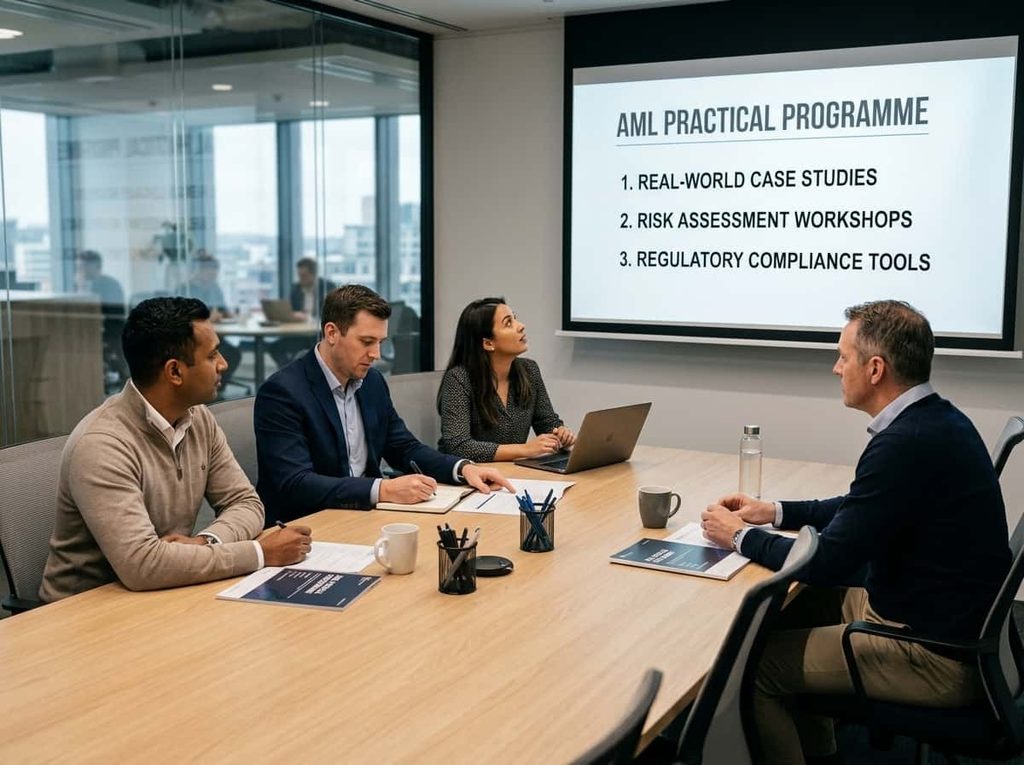
Practical Application Over Memorisation
Look for training that connects concepts to actual compliance responsibilities.
This can include case studies, financial crime scenarios, customer-risk examples, transaction monitoring situations, and practical discussions around escalation and controls.
The aim is to build knowledge that professionals can use within their roles.
Trainer and Practitioner Expertise
The experience behind an AML programme also matters.
Compliance is shaped by regulation, business models, technology, risk exposure, governance, and professional judgement. Training delivered with a clear understanding of how compliance functions operate can provide stronger context than purely theoretical material.
Recognised Professional Development
Structured professional qualifications can also form part of a wider compliance development strategy.
For professionals seeking a recognised pathway, CISI qualifications can support knowledge across financial services, compliance, financial crime, and risk. The appropriate level should depend on the individual’s role, experience, and development objectives rather than simply selecting the highest available qualification.
Training Should Reflect Role and Risk
Not every employee requires the same AML training.
The CBUAE recommends a risk-based approach in which the content, frequency, and intensity of training are aligned with the risks associated with different roles and functions (CBUAE, 2025a).
This makes a role-based approach particularly relevant for compliance officers, MLROs, risk professionals, front-line teams, and senior management.
How Should Organisations Assess Their AML Training Needs?
For organisations, choosing a course should begin with understanding the capability that needs to be developed.
Map Roles and Responsibilities
Identify which teams handle KYC, CDD, sanctions screening, transaction monitoring, investigations, reporting, governance, and independent testing.
This provides a clearer basis for determining who needs general awareness and who requires specialised training.
Identify Capability Gaps
Training needs can be informed by risk assessments, audit findings, regulatory observations, employee experience, and changes in responsibilities.
The CBUAE recommends an annual training needs assessment that considers factors such as the institution’s risk assessment, regulatory findings, audit results, and senior-management feedback (CBUAE, 2025c).
Align Training With Risk Exposure
Training should reflect the organisation’s products, services, customers, jurisdictions, technology, and financial crime risks.
For example, a fintech with digital onboarding and complex payment flows may have different training needs from a traditional financial institution.
Measure and Refresh Competence
AML training should not end when the course does.
The CBUAE expects financial institutions to maintain training records, assess understanding, and regularly review and update training materials as risks, regulations, policies, and business activities change (CBUAE, 2025a; CBUAE, 2025c).
AML Compliance Training for Financial Services Professionals in the UAE
For professionals working in UAE financial services, training is most useful when it supports both professional development and the responsibilities of the role.
Mukhtara provides CISI-accredited compliance training across Levels 2, 3, and 6, alongside broader regulatory compliance and financial risk advisory services for financial institutions and regulated businesses across the UAE and wider MENA region.
Training for Different Levels of Compliance Responsibility
Professional development needs vary.
Foundational training may be appropriate for professionals developing their understanding of financial services, while more advanced programmes may suit experienced compliance practitioners and those moving toward greater responsibility.
Mukhtara’s CISI training pathways provide structured options that can be considered alongside a professional’s current role, experience, and development objectives.
Connecting Training With the Wider Compliance Framework
Training should also be viewed as part of a broader compliance capability.
AML knowledge needs to connect with policies, procedures, governance, risk assessments, KYC/CDD controls, transaction monitoring, reporting, and ongoing risk management.
This is particularly important for organisations that need to build capability across teams rather than simply record course completion.
Building Capability Beyond Course Completion
Effective compliance depends on continued professional development.
As regulatory expectations, products, technologies, and financial crime risks change, organisations need to review whether their people remain equipped to perform their responsibilities.
Training can therefore be one component of a wider approach to maintaining regulatory competence.
Why Work With Mukhtara Compliance?
Mukhtara combines professional training with broader regulatory compliance expertise across the UAE and GCC.
Its services include CISI-accredited compliance training, regulatory gap analysis, compliance framework design, AML/KYC advisory, enterprise risk assessment, and ongoing risk monitoring.
This broader perspective allows training requirements to be considered alongside the regulatory and operational environment in which a compliance function operates.
Choose an AML Training Approach That Matches Your Role and Risk
An effective AML training course should do more than deliver information. It should help professionals understand the risks relevant to their work, interpret regulatory requirements, and apply appropriate controls within their organisation.
For financial-services professionals and organisations in the UAE, the right approach should reflect the applicable regulatory framework, business model, risk exposure, and professional responsibilities.
If you are assessing an AML training pathway, developing team capability, or considering CISI-accredited professional training, explore Mukhtara’s compliance training and regulatory advisory services to identify an approach aligned with your requirements.