

Operational risk rarely begins with a major failure. It can start with a weak process, unclear ownership, a system outage, poor controls, or over-reliance on a third-party provider.
For financial institutions in the UAE, these risks now sit within a clearer regulatory framework. The Central Bank of the UAE (CBUAE) Operational Risk Management Regulation, C 1/2026, requires all Licensed Financial Institutions that are juridical persons to implement a comprehensive framework for managing Operational Risk and Operational Resilience. The regulation became effective on 14 September 2026 (Central Bank of the UAE [CBUAE], 2026)..
Understanding these requirements is the first step. The next is determining whether an institution’s existing framework can meet them in practice.
Understanding Operational Risk in the UAE Financial Sector

Operational risk management is concerned with how an institution identifies, assesses, monitors, reports, and controls risks arising from its operations.
What Is Operational Risk?
Operational risk can arise from inadequate or failed internal processes, people and systems, or external events. In practice, this may include human error, technology failures, weak internal controls, fraud, process breakdowns, or disruption caused by a third-party service provider.
For a financial institution, even a small operational weakness can affect customers, regulatory obligations, business continuity, or critical operations.
An effective operational risk framework therefore needs to look beyond individual incidents and consider how risks are connected across the organisation.
Why Does Operational Risk Matter to Financial Institutions?
Operational risk affects more than the risk function. It can involve business units, compliance, technology, internal audit, senior management, and the Board.
This is why operational risk management needs to be integrated into the wider risk management and governance framework rather than treated as a standalone policy document. The CBUAE requires this broader integration under C 1/2026 (CBUAE, 2026).
Operational Risk and Operational Resilience: What’s the Difference?
Operational risk management focuses on identifying and managing risks that could affect the institution.
Operational resilience focuses on the institution’s ability to respond to, adapt to, recover from, and learn from disruptive events while continuing to deliver critical operations.
The CBUAE requires LFIs to maintain an Operational Resilience strategy that is integrated with their Operational Risk management framework (CBUAE, 2026).
What Does the CBUAE Operational Risk Regulation Require?
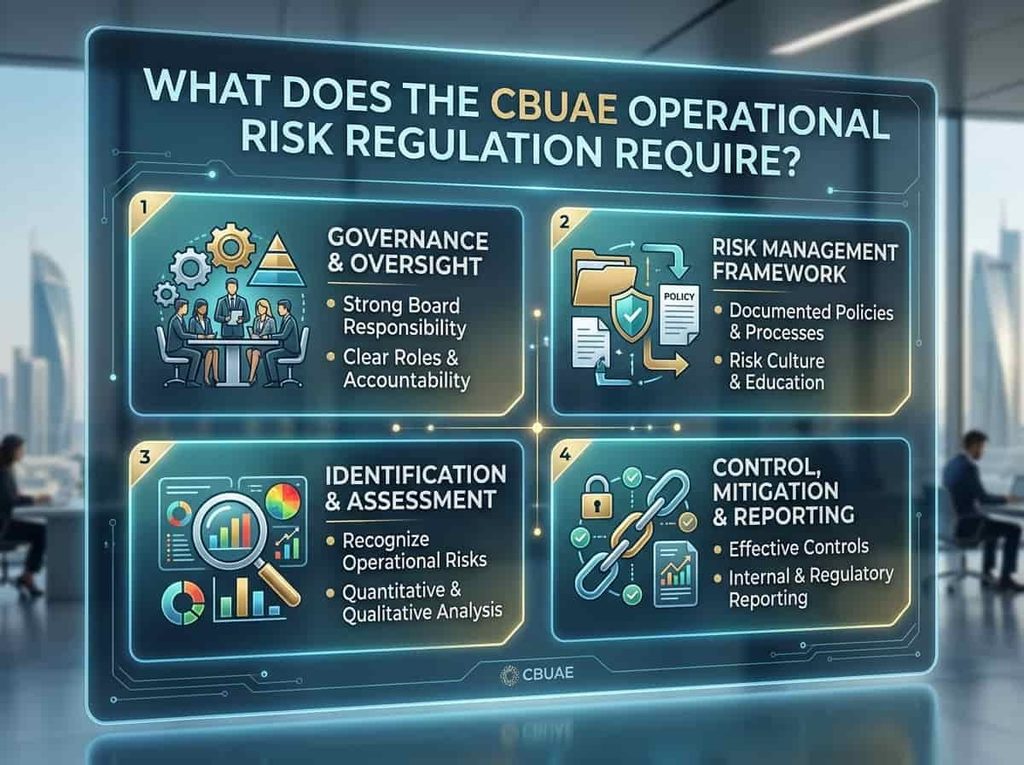
The CBUAE’s Operational Risk Management Regulation C 1/2026 establishes minimum requirements for managing Operational Risk and Operational Resilience.
Who Does the CBUAE Regulation Apply To?
The regulation applies to Licensed Financial Institutions that are juridical persons. This means firms should first establish whether the CBUAE framework applies to their specific regulatory status before assessing their obligations.
This distinction matters because UAE financial services businesses can operate under different regulatory frameworks and authorities.
What Is an Operational Risk Management Framework?
The CBUAE requires an LFI to have an appropriate operational risk management framework containing strategies, policies, procedures, systems, controls, and processes to identify, assess, evaluate, monitor, report, and control or mitigate Operational Risk.
The framework must also be fully integrated into the institution’s broader risk management and governance framework (CBUAE, 2026).
This means compliance should not stop at creating a policy. Institutions need processes and controls that can operate consistently across their business.
What Should an Effective Operational Risk Framework Include?

A regulatory framework becomes more useful when its requirements are translated into practical responsibilities.
Governance, Accountability and Oversight
A sound framework should establish clear reporting lines, responsibilities, accountabilities, and delegation of authority.
The CBUAE places ultimate responsibility on the Board for ensuring that an adequate Operational Risk management framework is in place. Senior Management is responsible for translating the Board-approved framework into effective policies, processes, controls, and systems (CBUAE, 2026).
Operational Risk Appetite and Tolerance
Institutions should also define their Operational Risk appetite and tolerance.
These help establish the level of risk the institution is willing to accept and the limits or thresholds that require management attention.
The CBUAE requires the Board to approve and review the institution’s Operational Risk appetite and tolerance, including appropriate risk limits and thresholds (CBUAE, 2026).
Risk Identification, Controls and Monitoring
An operational risk framework should provide a structured way to identify and assess risks across products, activities, processes, and systems.
It should also support effective internal controls, monitoring, reporting, and mitigation.
The CBUAE’s internal control requirements include risk assessment, control activities, monitoring, and information and communication. Reporting should also provide management with information that is comprehensive, accurate, consistent, timely, and actionable (CBUAE, 2026).
Operational Risk Management: How Can UAE Firms Align Their Framework With CBUAE Requirements?

Understanding the regulation is only the beginning. The more important question is whether the existing framework works against those requirements.
Start With a Regulatory Gap Analysis
A structured regulatory gap analysis can compare the institution’s current framework with applicable CBUAE requirements.
The review may consider governance, policies, risk appetite, controls, reporting, operational resilience, ICT risk, third-party arrangements, and incident management.
This helps distinguish between requirements that are already addressed and areas that may require further development.
Review Governance and Accountability
Firms should examine whether responsibilities are clearly assigned across the Board, Senior Management, business functions, risk management, compliance, and internal audit.
Clear ownership is important because operational risk can cross several functions. A control may exist, but its effectiveness can still depend on who monitors it, who receives the reporting, and who acts when a threshold is exceeded.
Assess Critical Operations and Dependencies
Operational resilience also requires firms to understand their critical operations and the resources that support them.
The CBUAE requires LFIs to identify the people, technology, processes, data, facilities, and third-party service providers needed to deliver critical operations during disruption (CBUAE, 2026).
This makes dependency mapping an important part of operational risk management.
Review ICT and Third-Party Risk
Technology and external providers can create significant operational dependencies.
Under C 1/2026, ICT and cybersecurity risk must be addressed within the Operational Risk management framework and Operational Resilience approach. The regulation also requires LFIs to assess, monitor, and manage third-party risk, including arrangements affecting critical operations (CBUAE, 2026).
For firms that rely heavily on technology providers or outsourced services, these areas deserve particular attention.
Common Operational Risk Management Gaps UAE Firms Should Examine
Some practical questions can help firms assess the strength of their current framework.
Are Policies Supported by Effective Controls?
A policy may describe what should happen, but firms also need processes and controls that demonstrate how requirements are implemented.
Are Risk Reports Actionable?
Risk reporting should help decision-makers understand material exposures, emerging issues, thresholds, and required actions.
Are Third-Party Dependencies Mapped?
Institutions should understand which critical operations depend on external providers and how those dependencies would be managed during disruption.
Is Operational Resilience Integrated?
Operational resilience should connect with operational risk management, business continuity, technology, and broader governance rather than operate as a separate exercise.
Operational Risk Management Compliance Support for UAE Licensed Financial Institutions
For some institutions, strengthening the framework requires more than an internal review. External regulatory expertise can provide an independent view of current arrangements and potential gaps.
Regulatory Gap Analysis
Mukhtara provides regulatory gap analysis that maps an organisation’s current state against applicable regulatory obligations, including CBUAE, DFSA, and SCA frameworks.
Compliance Framework Design and Implementation
Mukhtara also supports the development and enhancement of policies, procedures, governance structures, and control frameworks for regulated businesses.
Enterprise Risk Assessment and Ongoing Monitoring
Its services include enterprise risk assessment and ongoing risk monitoring, helping organisations assess regulatory, financial, and operational exposure and maintain an up-to-date view of their risk environment.
Mukhtara works with financial institutions, fintechs, and regulated entities across the UAE, GCC, and wider MENA region. Its stated services span regulatory compliance, risk assessment, compliance framework design, and CISI-accredited practitioner training (Mukhtara Compliance, 2026).
Why Work With Mukhtara Compliance?
Operational risk requirements need to be understood within the institution’s actual business model, regulatory perimeter, and risk profile.
Mukhtara’s approach begins with assessment and moves through framework design, implementation and training, followed by ongoing advisory support. Its advisers hold active CISI qualifications and work across UAE and MENA regulatory frameworks.
This approach is designed to connect regulatory requirements with the policies, controls, governance, and processes that support day-to-day compliance.
Strengthen Your Operational Risk Framework
The CBUAE’s current requirements make operational risk management a structured governance responsibility for applicable Licensed Financial Institutions.
For firms reviewing their framework, the practical starting point is to understand the applicable requirements, assess the current state, identify material gaps, and establish a clear path for remediation.
If your organisation is reviewing its operational risk framework or assessing alignment with CBUAE requirements, explore Mukhtara’s regulatory compliance services or speak directly with an adviser to discuss a structured regulatory gap analysis.