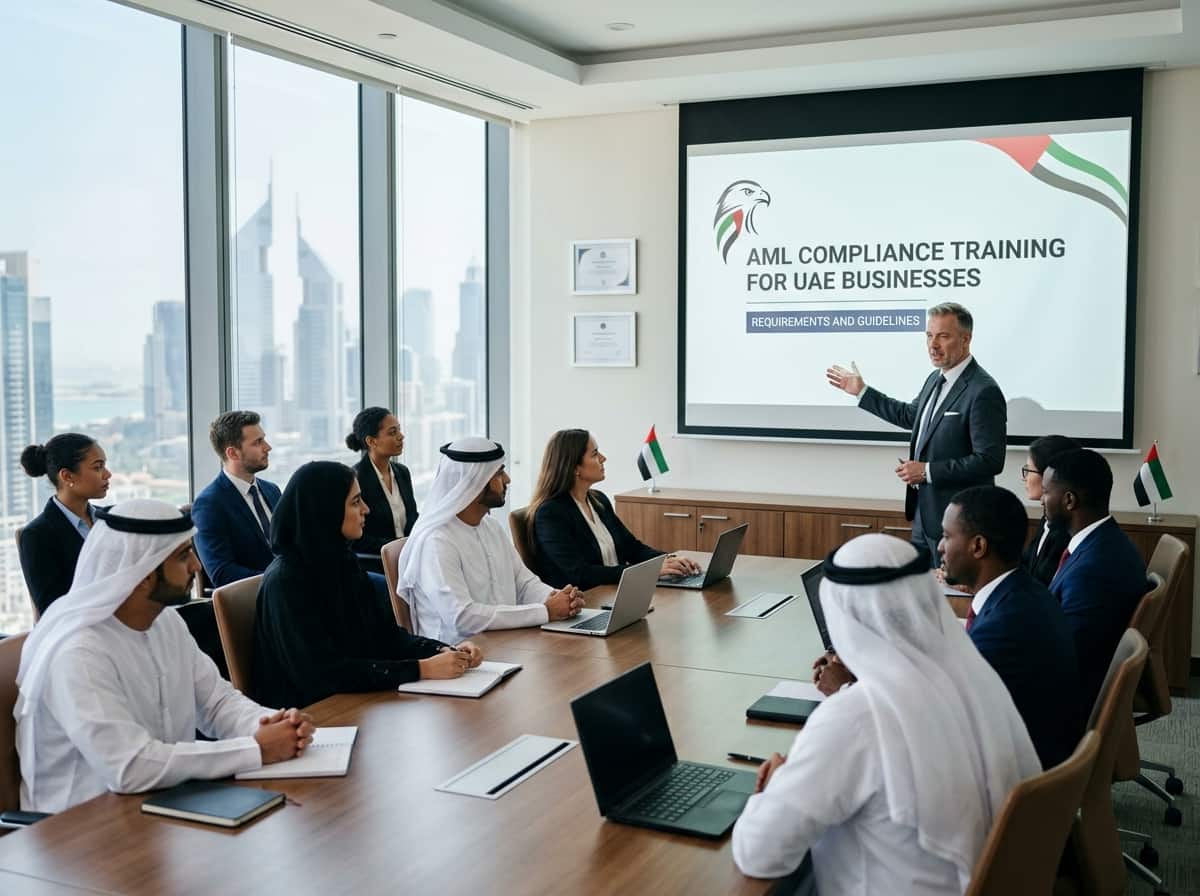
AML training is an important part of an effective financial crime compliance framework. Policies and procedures may define what employees should do, but training helps ensure they understand how to apply those controls in practice.
For businesses operating in the UAE, the right training approach depends on the firm’s sector, regulatory status, business model, and exposure to money laundering, terrorist financing, and proliferation financing risks. For firms supervised by the Central Bank of the UAE (CBUAE), current guidance places strong emphasis on enterprise-wide awareness, role-based training, ongoing updates, and documented evidence of training. (Central Bank of the UAE [CBUAE], 2025).
What Is AML Training?
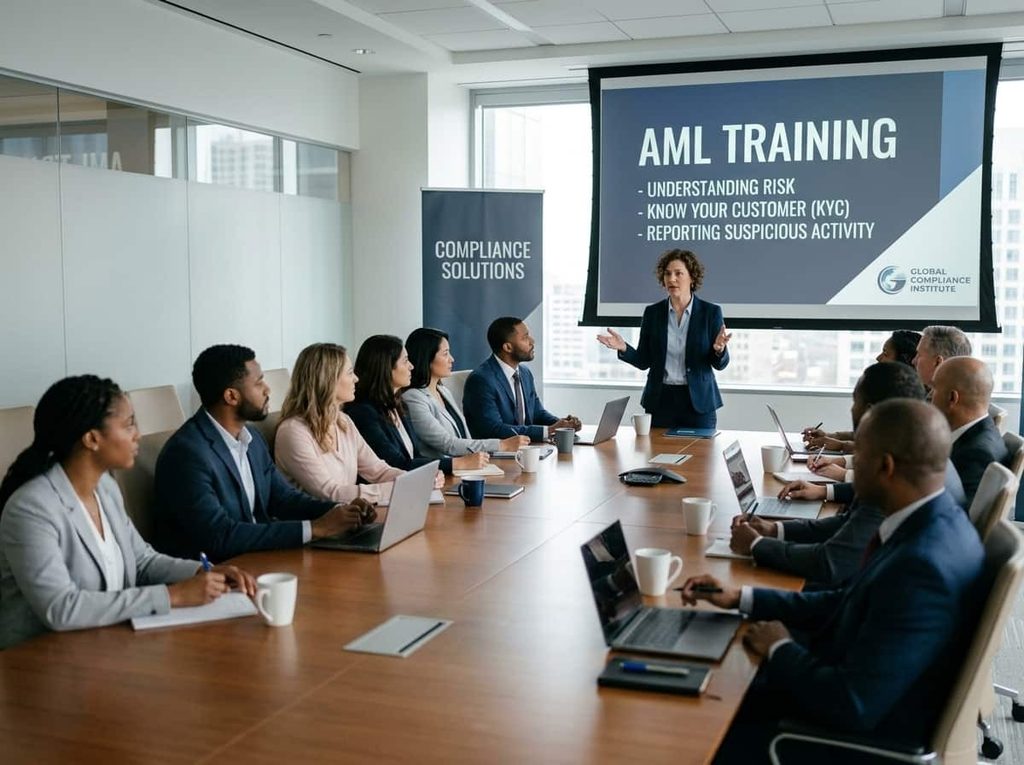
AML training gives employees the knowledge and practical understanding needed to identify and manage financial crime risks. It is broader than completing a course or receiving a certificate.
An effective programme should help employees understand relevant AML/CFT/CPF requirements, internal policies, customer risks, warning signs, escalation procedures, and the controls linked to their roles.
What Does AML Training Usually Cover?
Depending on the employee’s responsibilities, training may cover:
- Anti-money laundering and counter-terrorist financing requirements
- Proliferation financing risks
- Know Your Customer (KYC) and customer due diligence (CDD)
- Sanctions screening
- Transaction monitoring
- Suspicious activity and escalation procedures
- Financial crime red flags and typologies
- Internal AML policies and procedures
- Customer and transaction risk
- Regulatory developments
The content should reflect the organization’s actual risks rather than rely on generic material.
Who Needs AML Training?
AML training should not be limited to the compliance department.
Employees who deal with customers, products, transactions, risk management, technology, internal controls, or financial crime systems may all require training relevant to their responsibilities. Boards and senior management also need sufficient knowledge to understand the organization’s financial crime risks and compliance responsibilities.
For CBUAE-supervised Licensed Financial Institutions (LFIs), current guidance includes new-hire training, annual enterprise-wide training, localized training, Board and senior-management training, and role-based training.
Is AML Training Mandatory in the UAE?
There is no single training programme that applies in exactly the same way to every business in the UAE. The applicable requirements depend on the firm’s regulatory framework and supervisory authority.
For CBUAE-supervised LFIs, however, the current CBUAE guidance sets clear expectations for comprehensive AML/CFT/CPF training. It states that all staff should receive AML/CFT/CPF awareness training at least annually, while relevant employees should receive targeted and role-based training. New employees should also receive required training within the timeframe established by the LFI.
This distinction matters. A business should first establish which regulatory obligations apply to it before designing its training programme.
How Often Should AML Training Be Conducted?
For CBUAE-supervised LFIs, AML/CFT/CPF awareness training should be provided at least annually to all staff. Training should also continue when regulations, internal policies, procedures, or financial crime risks change.
AML Training for New Employees
New employees should receive appropriate AML/CFT/CPF training as part of their onboarding. Training should reflect the responsibilities they will perform and the risks connected to their role.
Employees who move into new positions may also require additional training if their responsibilities expose them to different financial crime risks.
Refresher and Ongoing AML Training
Annual training should not be treated as the end of the compliance cycle.
New regulations, emerging financial crime typologies, new products, technology changes, audit findings, and changes in internal procedures can create new training needs. A strong programme therefore includes ongoing updates and targeted refresher training where required.
AML Training: Understanding CBUAE Requirements for Regulated Financial Institutions
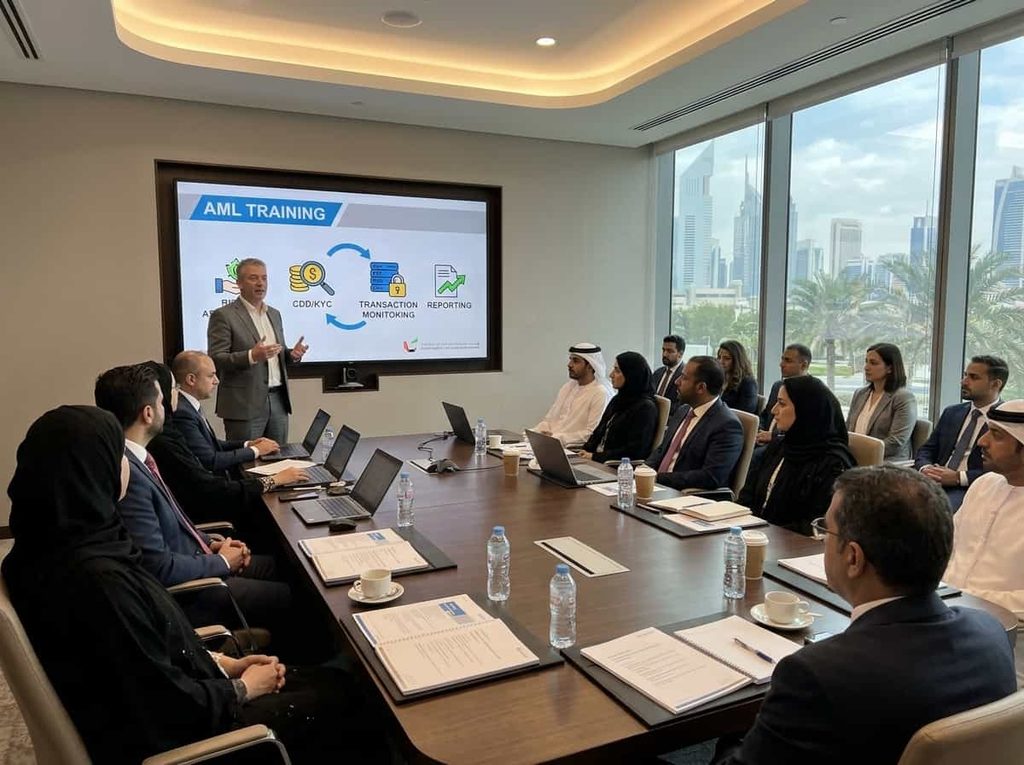
For CBUAE-supervised LFIs, AML training forms part of the wider AML/CFT/CPF compliance programme. The CBUAE takes a risk-based and role-based approach, meaning training should reflect the responsibilities and financial crime exposure of different employees.
This is important because a relationship manager, compliance officer, internal auditor, Board member, and employee supporting a financial crime monitoring system do not face the same risks or perform the same functions.
Annual Enterprise-Wide AML/CFT/CPF Training
CBUAE guidance calls for annual AML/CFT/CPF awareness training for all staff within an LFI.
This establishes a baseline level of awareness across the organization. Employees should understand the firm’s financial crime risks and their own responsibilities within the compliance framework.
Role-Based AML Training
Role-based training goes further.
The CBUAE states that training should be tailored to employees’ responsibilities, the risks associated with their functions, relevant regulatory requirements, internal procedures, and the LFI’s products, services, customers, and geographic locations.
For example, front-line employees may need greater focus on customer risk and financial crime red flags. Compliance teams may require deeper training on AML controls, regulatory obligations, investigations, and monitoring. Independent testing functions may require training that supports effective review of the AML/CFT/CPF framework.
AML Training for Boards and Senior Management
Senior leaders have a different responsibility from operational employees.
Board members and senior management need to understand the institution’s financial crime risk exposure, governance responsibilities, and the effectiveness of its control framework. CBUAE guidance includes Board and senior-management training within its broader training expectations.
What Should a CBUAE-Aligned AML Training Programme Include?

A strong programme should begin with the organization’s risk profile.
It should consider the products and services offered, customer types, geographic exposure, delivery channels, employee responsibilities, and known financial crime risks.
Conducting an AML Training Needs Assessment
Training needs should not be based only on an annual calendar.
CBUAE guidance states that an annual training needs assessment should consider the LFI’s risk assessment, regulatory findings, audit results, employee skills and experience, and relevant feedback from senior management. The assessment should be documented and used to identify areas that may require enhanced AML/CFT/CPF training (CBUAE, 2025).
This creates a stronger connection between risk assessment and employee capability.
Aligning Training With Internal Policies and Controls
Training should also explain how employees apply the organization’s actual controls.
For example, employees should understand how KYC information is collected, when CDD or enhanced due diligence may be required, how sanctions alerts are handled, how unusual activity is escalated, and where relevant records are maintained.
The objective is not simply to know the rules. It is to apply them consistently.
How Should AML Training Be Documented?
A regulated firm’s training programme should be supported by clear documentation.
CBUAE guidance expects LFIs to maintain an annual training plan covering participants, topics, delivery methods, objectives, minimum standards, frequency, dates, and assessment methods. Training attendance and assessment records should also be maintained.
Measuring AML Training Effectiveness
Completion alone does not demonstrate that training was effective.
Organizations can use assessments, quizzes, feedback, performance reviews, and other competency checks to determine whether employees understand the material and can apply it in practice.
The CBUAE also expects mechanisms to verify employee understanding and appropriate follow-up where employees do not complete required training or fail assessments.
Common AML Training Gaps in Regulated Firms
Several weaknesses can reduce the value of an AML training programme:
- Using the same generic content for every employee
- Focusing on completion rather than understanding
- Failing to update training after regulatory changes
- Not linking training to the firm’s risk assessment
- Weak documentation and attendance records
- Limited training for senior management
- Not addressing findings from audits or regulatory reviews
- Failing to provide enhanced training to higher-risk functions
These gaps can make training look complete on paper while leaving practical weaknesses in the compliance framework.
UAE AML Training Support: Aligning Training Programmes With CBUAE Expectations
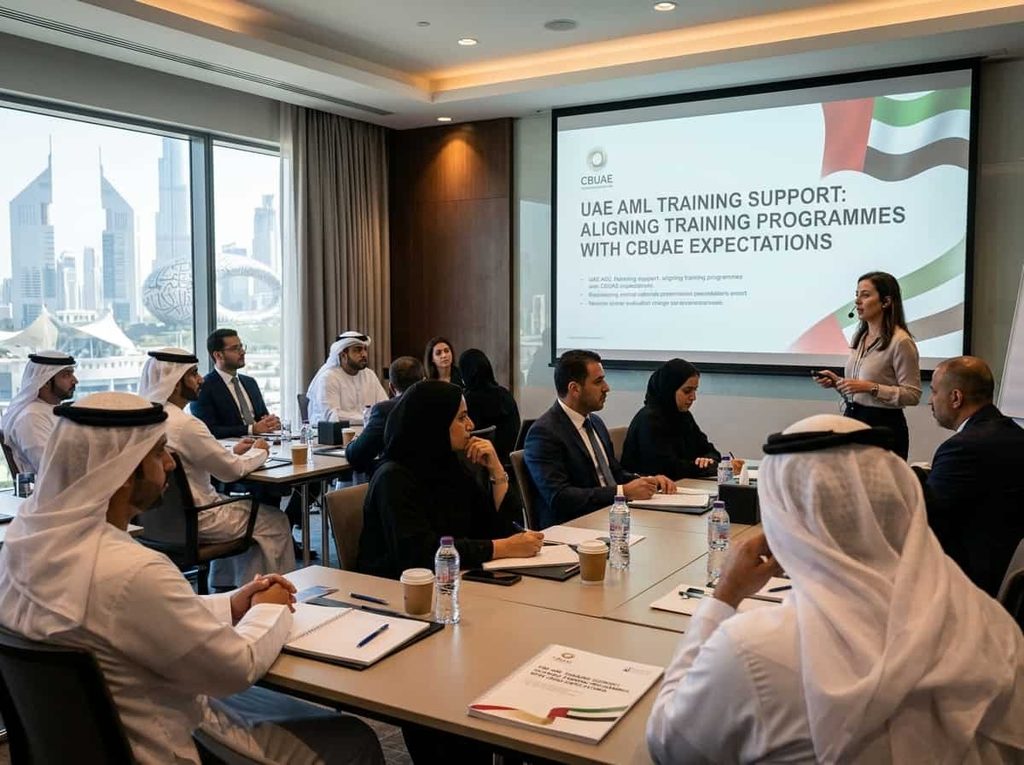
Effective AML training should support the wider compliance framework rather than operate as a standalone activity.
For regulated firms, this means assessing existing training against applicable requirements, identifying role-specific gaps, reviewing training documentation, and ensuring the programme reflects the firm’s current risk profile.
Mukhtara Compliance supports financial institutions, fintechs, and other regulated entities across the UAE, GCC, and wider MENA region through regulatory compliance advisory, AML/KYC programme development, compliance training, risk management, and regulatory assessments. Its approach connects assessment, framework design, implementation, training, and ongoing advisory support.
Strengthen Your AML Training Framework
A practical review can help determine whether your current programme is appropriately aligned with your regulatory obligations, business risks, employee responsibilities, and internal controls.
For organizations operating under CBUAE, DFSA, SCA, or other applicable regulatory frameworks, training should be considered alongside the wider compliance environment.
If your organization is reviewing its AML training programme or preparing for regulatory scrutiny, speak with Mukhtara Compliance to assess your current framework, identify potential gaps, and determine the appropriate next steps for strengthening regulatory capability.
Conclusion
AML training is most effective when it is treated as part of the organization’s wider financial crime control framework. For CBUAE-supervised institutions, current guidance goes beyond annual awareness. It emphasizes role-based training, risk assessment, ongoing updates, documentation, and evidence that employees understand their responsibilities.
For UAE businesses, the right approach begins with understanding the applicable regulatory framework and then building training around actual business risks and employee responsibilities.
Review your AML training framework with Mukhtara Compliance and identify where your programme can be strengthened, documented, and aligned with applicable UAE regulatory expectations.