
In financial services, professional knowledge is not static. Regulations evolve, financial crime risks change, and compliance teams are expected to understand more than policies alone. For professionals building a career in compliance, risk, or financial crime, choosing the right CISI qualification can help strengthen technical knowledge and support long-term professional development.
The Chartered Institute for Securities & Investment (CISI) offers a Compliance & Risk pathway covering areas such as financial services fundamentals, global financial compliance, financial crime, risk, and advanced investment compliance. However, choosing a qualification should not be based on level alone. Your role, experience, responsibilities, and career objectives all matter.
For professionals working in the UAE, there is another important consideration: professional qualifications should complement, rather than replace, knowledge of the regulatory framework that applies to your organisation.
What Is CISI?

The Chartered Institute for Securities & Investment (CISI) is a professional body serving the financial services sector. Its qualifications cover several areas, including compliance and risk, wealth management, operations, capital markets, financial planning, and other specialist disciplines.
For compliance professionals, the CISI Compliance & Risk pathway is particularly relevant. It includes qualifications such as Fundamentals of Financial Services, Global Financial Compliance, Combating Financial Crime, Risk in Financial Services, and the Diploma in Investment Compliance. CISI describes the pathway as progressive, while also noting that the qualification levels are a guide rather than a mandatory sequence.
This distinction matters. A more advanced qualification is not automatically the right qualification for every professional.
Why Do Professional Qualifications Matter in Financial Services?

Compliance professionals work in an environment where technical knowledge and sound judgment are both important. A structured qualification can help professionals develop their understanding of financial services, regulation, governance, risk management, and financial crime.
However, examination knowledge and practical compliance experience are not the same.
A professional may understand AML, KYC, or financial crime principles but still need experience applying those principles to real business situations. This includes reviewing customer risks, assessing controls, supporting regulatory obligations, and understanding how internal policies operate in practice.
For this reason, a CISI qualification is best viewed as part of a broader professional development strategy.
Who Can Benefit From CISI Qualifications?
CISI qualifications can be relevant to professionals at different stages of their compliance careers.
| Professional Profile | Relevant CISI Qualification | How It Supports the Role |
| Compliance Professionals | Level 3 Award in Global Financial Compliance | Provides a broad understanding of compliance issues within financial services and is particularly relevant to Compliance Officers and compliance staff. |
| Financial Crime Professionals | Level 3 Award in Combating Financial Crime | Supports professionals working in AML and financial crime functions. CISI identifies Compliance Officers and Money Laundering Reporting Officers (MLROs) among the relevant audience. |
| Risk Professionals | Risk in Financial Services | Covers risk management, corporate governance, risk oversight, and key financial-services risks. It is relevant to risk and compliance teams. |
| Senior Compliance Professionals | Level 6 Diploma in Investment Compliance | Provides advanced compliance knowledge for experienced practitioners, including professionals progressing toward supervisory and senior management responsibilities. |
How Do CISI Qualification Levels Work?
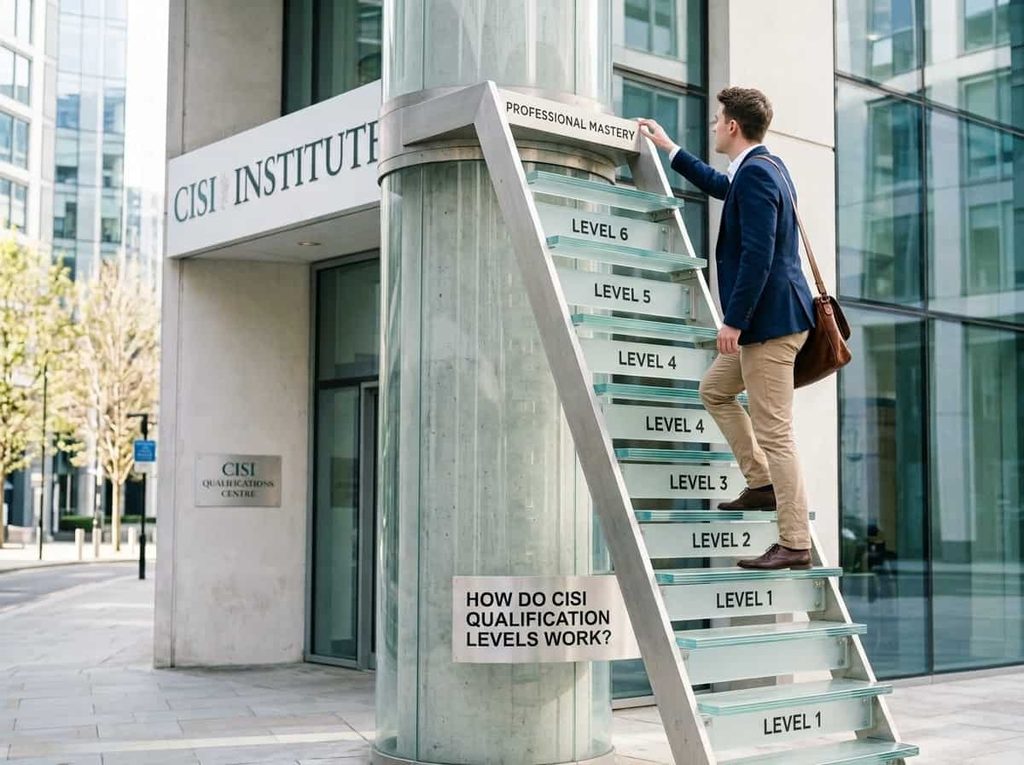
The Compliance & Risk pathway includes several qualifications at different levels.
Level 2 – Fundamentals of Financial Services can provide foundational financial-services knowledge.
Level 3 – Global Financial Compliance, Combating Financial Crime, and Risk in Financial Services provide more focused knowledge in compliance, financial crime, and risk.
Level 6 – Diploma in Investment Compliance provides advanced compliance knowledge for experienced practitioners.
CISI states that its Level 6 Diploma is designed for compliance practitioners, particularly those at supervisory level who aspire to senior management roles. It covers regulatory, specialist, and advanced aspects of compliance.
The important point is that professionals should select a qualification according to their actual development needs rather than simply choosing the highest level available.
CISI Qualifications: Understanding the CISI Pathway for Compliance Professionals

Once a professional understands the different options, the next question is more practical: Which CISI qualification fits the role?
The answer depends on several factors, including current responsibilities, experience, technical knowledge, financial crime exposure, and long-term career plans.
CISI Level 2: Building Foundational Knowledge
Professionals who are developing their understanding of financial services may benefit from a foundational qualification such as Fundamentals of Financial Services.
This can provide a broader base before moving into a more specialised area.
CISI Level 3: Developing Specialist Compliance Knowledge
Level 3 offers several relevant directions.
Global Financial Compliance focuses on compliance functions, financial crime risk, governance, risk management, ethics, and the international regulatory environment.
Combating Financial Crime provides a more focused understanding of financial crime, including money laundering, terrorist financing, corruption, and related controls.
Risk in Financial Services provides a broader risk-management perspective covering areas such as operational, credit, market, investment, and liquidity risk.
CISI Level 6: Advancing Toward Senior Compliance Responsibilities
The Level 6 Diploma in Investment Compliance is intended for more advanced compliance development. CISI describes it as suitable for practitioners, particularly those at supervisory level who are aspiring to senior management.
For an experienced compliance professional, this may provide a structured way to deepen knowledge across regulatory and specialist compliance areas.
How Should Compliance Professionals Choose a CISI Qualification?
A practical decision should begin with the professional’s current position.
First, consider your current compliance role. A junior compliance professional, Compliance Officer, MLRO, risk specialist, and senior compliance manager may have very different learning needs.
Next, consider your existing experience. Someone entering financial services may require broader foundational knowledge, while an experienced practitioner may need more specialised or advanced study.
Finally, consider your long-term career direction. Are you developing into compliance, specialising in financial crime, moving into risk, or preparing for senior management?
These questions provide a stronger basis for selecting a qualification than simply asking which level is “best.”
How Relevant Are CISI Qualifications to Compliance Professionals in the UAE?
For professionals working in the UAE, CISI knowledge should be considered alongside the regulatory environment in which the firm operates.
Depending on the organisation and its activities, professionals may need to understand requirements associated with authorities such as the Central Bank of the UAE (CBUAE), Dubai Financial Services Authority (DFSA), or Securities and Commodities Authority (SCA).
A professional qualification and local regulatory compliance are not interchangeable.
A CISI qualification can support technical knowledge and professional development, while practical compliance work still requires an understanding of applicable UAE requirements, internal policies, governance arrangements, AML/KYC controls, and the firm’s risk profile.
Choosing the Right CISI Qualification for Your Compliance Career in the UAE
The right pathway ultimately depends on where you are now and where your career is going.
| Professional objective | Potential CISI direction |
| Build financial-services fundamentals | Level 2 |
| Develop broader compliance knowledge | Level 3 Global Financial Compliance |
| Strengthen financial crime knowledge | Level 3 Combating Financial Crime |
| Develop risk-management knowledge | Level 3 Risk in Financial Services |
| Prepare for advanced compliance responsibilities | Level 6 Diploma in Investment Compliance |
This is a general guide, not a fixed career ladder. CISI itself describes its qualification levels as a guide, and individual circumstances should be considered before selecting a pathway.
How Can CISI Training Be Aligned With UAE Regulatory Responsibilities?
Professional development becomes more valuable when it connects with the responsibilities a professional handles every day.
For UAE financial institutions, this can mean considering how compliance knowledge relates to AML/KYC controls, financial crime risk, governance, regulatory obligations, internal policies, and risk management.
The goal should not be examination preparation alone. Strong compliance capability requires professionals to understand how regulatory principles apply to actual business activities and risks.
Building Competence Beyond Examination Preparation
Passing an examination demonstrates knowledge of a defined body of material. Effective compliance work requires more.
Professionals also need sound judgment, practical experience, regulatory awareness, and the ability to apply knowledge within their organisation.
That is why professional qualifications work best as part of a wider compliance competency and development framework.
How MCompliance Supports CISI-Accredited Compliance Training
For organisations and professionals in the UAE and GCC, MCompliance provides a practitioner-led approach to regulatory compliance and professional development.
Its services include CISI-accredited compliance training across Levels 2, 3, and 6, alongside broader regulatory compliance and financial risk advisory capabilities.
The focus is not simply on completing a course. Training can be considered within the wider context of an organisation’s compliance responsibilities, regulatory environment, and professional competency requirements.
Speak With MCompliance About Your CISI Qualification Pathway
Selecting a CISI qualification is ultimately a professional decision. The right pathway depends on your current role, experience, responsibilities, and future objectives.
If you are assessing the appropriate CISI qualification for your career or developing a compliance training programme for your organisation, MCompliance can help you evaluate the appropriate pathway within the context of your regulatory environment.
Explore MCompliance’s CISI-accredited training and regulatory compliance services to discuss your professional development or organisational requirements.