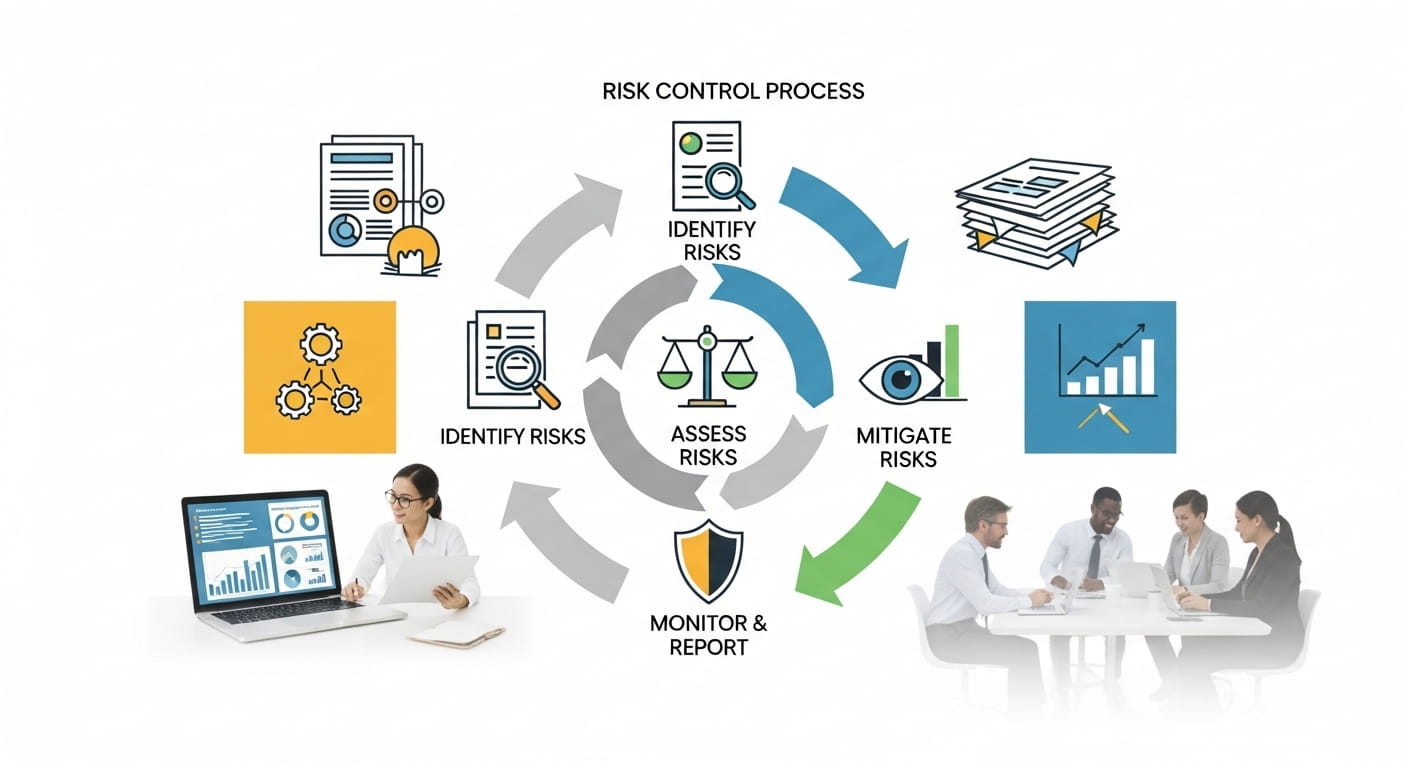

Businesses today operate in an environment where compliance expectations are growing every year. Regulators in the UAE and across global markets expect organizations to identify risks early, document controls clearly, and demonstrate accountability. Using a practical risk assessment example can help organizations understand how to evaluate potential threats, apply appropriate controls, and align their processes with regulatory expectations.
Yet many companies still ask the same question:
What does a real risk assessment example look like in corporate compliance?
Understanding this process helps businesses avoid penalties, pass audits smoothly, and build stronger governance systems. In this guide, we move step by step from understanding risk assessments to reviewing a practical example and finally learning when professional support becomes essential.
Understanding Business Risk Assessments: A Beginner’s Guide for Growing Companies

As organizations expand, risks become more complex. New employees, digital systems, vendors, and regulations introduce exposure that leaders may not immediately see.
A business risk assessment provides a structured way to identify and manage these risks before they become costly problems.
What Is a Business Risk Assessment?
A business risk assessment is a formal process used to identify, analyze, and reduce risks that may affect compliance, operations, finances, or reputation.
In corporate compliance, the focus is on regulatory exposure situations where a company may unintentionally violate laws or industry standards.
A typical assessment answers four core questions:
- What risks exist?
- How likely are they?
- What impact could they cause?
- How can they be controlled?
Regulatory authorities increasingly require documented risk-based approaches. The Financial Action Task Force (FATF) emphasizes a risk-based approach to help countries and reporting entities identify and manage money laundering and terrorist financing risks effectively (FATF, 2023).
This means risk assessments are no longer best practice; they are an expectation.
Why Growing Companies Struggle Without Risk Assessments
Many growing companies focus on revenue and operations while governance develops slowly. This creates gaps such as:
- unclear compliance responsibilities,
- outdated policies,
- inconsistent internal controls,
- unmanaged third-party risks.
In real consulting engagements, businesses often seek help only after facing audit findings or licensing delays. Without structured evaluation, risks remain hidden until regulators identify them.
A proactive assessment reduces uncertainty and gives leadership visibility over compliance exposure.
Key Components of an Effective Risk Assessment Framework
Most successful compliance programs follow a similar structure:
| Step | Description |
| Risk Identification | Recognizing potential compliance threats that could affect operations, finances, or regulatory obligations. |
| Risk Analysis | Understanding the likelihood of each risk occurring and the potential impact on the organization. |
| Risk Evaluation | Prioritizing risks using scoring models to determine which require immediate action. |
| Risk Mitigation | Designing and implementing controls or corrective actions to reduce exposure. |
| Monitoring | Continuously reviewing risks and controls to ensure effectiveness and adapt to changes. |
Organizations that apply this framework build stronger internal governance and demonstrate regulatory maturity.
When Businesses Typically Need a Risk Assessment
Companies usually conduct assessments during key transitions, including:
- entering regulated sectors in the UAE,
- preparing for ISO certification,
- implementing AML programs,
- expanding operations,
- preparing for regulatory inspections.
Early preparation saves significant time and cost compared to reactive compliance fixes.
Step-by-Step Breakdown of a Practical Risk Assessment Example for Corporate Compliance
Let’s now examine a practical risk assessment example used in a corporate compliance setting.
Imagine a mid-sized UAE company preparing for regulatory review while expanding operations.
Step 1 — Define Scope and Regulatory Requirements
The first step is defining what will be assessed.
This includes:
- departments involved,
- applicable UAE regulations,
- operational processes,
- responsible stakeholders.
A common mistake is limiting scope to one department. Regulators assess the organization as a whole.
Clear scoping ensures risks connected to governance, AML obligations, and data protection are properly considered.
Step 2 — Identify Compliance Risks
Next, risks are identified through interviews, document reviews, and workflow analysis.
Typical risks include:
- incomplete customer due diligence,
- insufficient employee compliance training,
- weak vendor monitoring,
- missing documentation trails.
Experienced assessors look beyond written policies and examine how processes work in daily operations.
Hidden gaps often exist where responsibilities are unclear.
Step 3 — Apply Risk Scoring Methodology
Each risk is evaluated using a likelihood-versus-impact model.
For example:
- Low likelihood + low impact = low risk
- High likelihood + severe regulatory penalty = critical risk
Structured scoring helps leadership prioritize resources logically.
The ISO 31000 risk management standard highlights structured evaluation as essential for consistent decision-making (International Organization for Standardization [ISO], 2018).
Documented scoring also demonstrates transparency during audits.
Step 4 — Evaluate Existing Controls
Organizations then review existing safeguards, such as:
- policies and procedures,
- approval workflows,
- monitoring systems,
- internal audits,
- staff training programs.
A frequent finding is that policies exist but are not actively followed. Regulators assess effectiveness, not documentation alone.
Questions asked include:
- Are employees trained regularly?
- Is compliance monitored?
- Are incidents recorded and escalated?
Control effectiveness directly influences final risk ratings.
Step 5 — Develop Risk Mitigation Actions
After evaluation, mitigation plans are created.
Actions may include:
- updating policies,
- automating monitoring systems,
- strengthening governance oversight,
- conducting targeted staff training.
Mitigation plans should include clear owners and timelines. Without accountability, improvements rarely succeed.
Step 6 — Documentation and Reporting
Documentation is one of the most critical outcomes of a risk assessment.
Organizations prepare:
- risk registers,
- executive summaries,
- mitigation roadmaps,
- audit-ready reports.
An effective enterprise risk management approach with transparent risk reporting can improve decision-making, support regulatory communication, and boost stakeholder confidence (Deloitte, 2023).
Well-documented assessments demonstrate control, transparency, and leadership awareness.
Common Mistakes Companies Make
From real-world experience, the most frequent errors include:
- copying generic templates,
- treating assessments as one-time tasks,
- failing to assign ownership,
- ignoring monitoring after completion.
Risk management must evolve alongside the business.
Professional Risk Assessment Services: What to Expect Before Hiring a Compliance Partner
As compliance requirements grow more complex, many organizations choose external experts to ensure accuracy and regulatory alignment.
Signs Your Organization Needs Professional Support
You may benefit from expert guidance if:
- a regulatory audit is approaching,
- internal expertise is limited,
- compliance responsibilities are unclear,
- expansion introduces new regulatory obligations.
External specialists bring structured methodologies and industry insight that internal teams may lack.
What a Professional Engagement Typically Includes
A professional compliance risk assessment usually delivers:
- regulatory mapping,
- gap analysis,
- structured risk scoring,
- mitigation strategy,
- executive-level reporting.
Experienced advisors also help implement improvements, not just identify problems.
For UAE-based organizations, local regulatory understanding is essential. Compliance expectations differ across sectors and jurisdictions, making regional expertise valuable.
Why Work With a Specialized Compliance Firm
Partnering with a dedicated compliance consultancy provides:
- reduced regulatory risk,
- faster audit preparation,
- stronger governance frameworks,
- improved investor and stakeholder confidence.
Firms like MCompliance support organizations through practical, tailored compliance solutions aligned with UAE regulatory requirements. Their structured approach helps businesses move from reactive compliance to proactive risk management.
Start Building a Compliance-Ready Organization Today

A well-executed risk assessment does more than satisfy regulators; it protects your operations, reputation, and future growth.
Understanding a risk assessment example is the first step. Implementing it correctly is where real value begins.
If your organization is preparing for an audit, expanding operations, or strengthening governance, professional guidance can simplify the process and reduce uncertainty.
Explore MCompliance’s Risk Assessment and Regulatory Compliance Services to identify gaps early and build a clear, practical compliance roadmap tailored to your business.
Contact the team today to schedule a consultation and take the first step toward confident compliance.
Frequently Asked Questions (FAQ)
1. What is a risk assessment in corporate compliance?
A corporate compliance risk assessment is a structured process that identifies, analyzes, and evaluates risks that could lead to regulatory violations or operational failures. It helps organizations prioritize actions and implement controls to mitigate these risks.
2. Why is a risk assessment important for UAE businesses?
UAE regulators increasingly expect documented compliance processes. Risk assessments help companies identify potential gaps, prevent penalties, and demonstrate accountability to authorities such as the UAE Central Bank and other regulatory bodies.
3. How often should a risk assessment be conducted?
Risk assessments should be ongoing, but formal reviews are typically conducted at least annually, or whenever there is a significant business change such as entering a new market, introducing a new service, or after regulatory updates.
4. Can small or medium-sized businesses benefit from a risk assessment?
Yes. Even small or medium-sized enterprises face compliance obligations. Conducting a risk assessment helps prevent unexpected fines, improves operational efficiency, and builds investor and customer confidence.
5. Do I need a professional compliance partner for a risk assessment?
While internal teams can conduct assessments, professional compliance consultants provide expertise, structured methodologies, and regulatory insight especially critical for UAE regulations. Partnering with a compliance firm ensures your assessment is thorough, accurate, and audit-ready.