

Today, businesses collect and use more personal data than ever before. Customer records, employee files, website analytics, marketing platforms, and cloud applications all support growth—but they also create responsibility. Maintaining strong GDPR compliance practices helps organizations protect personal data, meet regulatory requirements, and build trust with customers.
For many organizations operating in the UAE and across the MENA region, GDPR compliance becomes relevant the moment they offer services to EU individuals, process EU personal data, support European clients, or track online behavior across borders. GDPR obligations can extend beyond Europe depending on business activities and data flows.
Yet one challenge appears again and again: businesses often believe compliance is mainly documentation.
In reality, strong compliance comes from daily processes, governance, accountability, and continuous monitoring.
Why Businesses Continue to Struggle With GDPR Compliance

Most organizations do not intentionally ignore regulations.
The challenge is usually operational.
New systems are introduced. Teams expand. Vendors gain access. Data moves faster than governance processes.
Over time, hidden gaps appear.
Compliance Is Often Treated as a One-Time Exercise
One of the biggest mistakes organizations make is treating compliance as a project that ends after policies are written.
Typical signs include:
- Policies created but rarely updated
- Privacy notices that no longer match operations
- Undefined ownership across departments
- Controls implemented without ongoing review
Strong privacy governance should evolve alongside the business.
A practical rule:
Documentation creates structure. Processes create consistency. Monitoring creates resilience.
Rapid Digital Growth Creates Hidden Exposure
Digital transformation creates efficiency—but also complexity.
Cloud platforms, outsourced providers, AI tools, and international expansion can introduce new personal data processing activities that were never assessed.
Organizations that build compliance into business operations early are often better positioned to scale safely and maintain stakeholder confidence.
Top GDPR Compliance Mistakes Businesses Make (and How to Avoid Them)

Small process failures often become larger regulatory issues.
Recognizing them early reduces both operational disruption and compliance pressure.
1. Collecting More Personal Data Than Necessary
Many businesses gather information simply because systems allow it.
Over time this creates duplicate records, unnecessary storage, and increased risk.
Ask:
Do we genuinely need every piece of information we collect?
Good practices include:
- Reviewing all collection forms
- Applying data minimization principles
- Defining retention schedules
- Removing outdated records
Collect less. Protect better.
2. Weak Consent and Transparency Controls
Consent management is more than adding a checkbox.
Businesses should ensure consent is:
- Clear
- Specific
- Easy to withdraw
- Properly recorded
Customers increasingly expect transparency around how their information is handled.
Improving visibility often strengthens both compliance outcomes and trust.
3. Inadequate Vendor and Third-Party Oversight
Third parties frequently process sensitive information.
Common examples include:
- Payroll providers
- Cloud vendors
- Marketing platforms
- Technology service providers
Questions to review:
- What information can the vendor access?
- Is responsibility documented?
- Are controls tested?
Outsourcing processing does not remove accountability.
4. Delayed Responses to Data Requests
Individuals expect timely access to their information.
Organizations should prepare for:
- Access requests
- Correction requests
- Deletion requests
- Objection requests
Simple improvements include:
- Clear intake channels
- Defined ownership
- Workflow tracking
- Evidence of completion
5. Treating Employee Information as Lower Risk
Privacy obligations extend beyond customers.
Employee data often contains highly sensitive information and should receive the same level of governance and protection.
Areas to strengthen:
- Access management
- Retention practices
- Internal transparency
- Secure storage standards
6. Operating Without Continuous Governance
Compliance environments constantly change.
Policies written a year ago may no longer reflect business reality.
Leading organizations build repeatable review cycles that include:
- Internal assessments
- Control testing
- Vendor reviews
- Policy maintenance
- Governance reporting
Five Practical Actions to Start This Month
- Map personal data locations
- Review consent practices
- Assess vendor agreements
- Test request processes
- Schedule a compliance review
GDPR Compliance Gap Analysis: Identifying Risks Before They Become Penalties
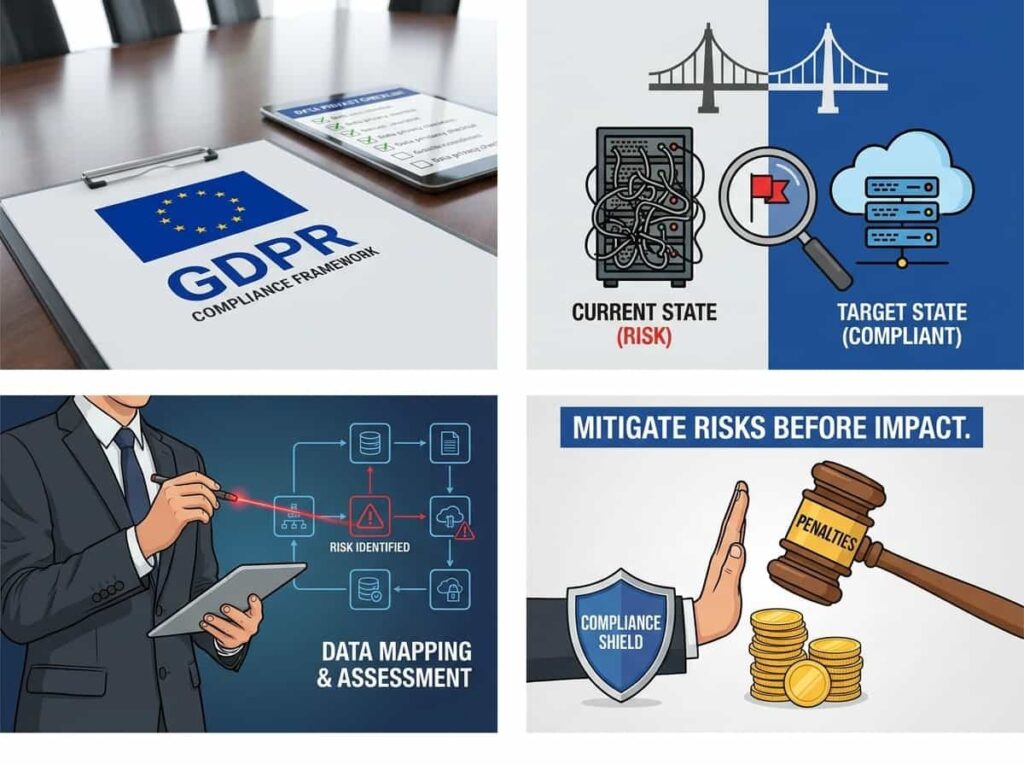
Awareness creates understanding.
Assessment creates action.
A GDPR compliance gap analysis helps organizations compare current operations against expected regulatory requirements.
Rather than assuming controls exist, organizations validate whether they actually work.
What a GDPR Compliance Gap Analysis Measures
An effective assessment reviews:
- Governance arrangements
- Processing activities
- Policies and procedures
- Technical safeguards
- Operational controls
- Evidence and reporting
The objective is practical improvement—not paperwork.
A Six-Step Framework for Identifying Compliance Gaps
| Step | GDPR Compliance Gap Analysis Activity | What This Step Covers |
| 1 | Map Personal Data Activities | Understand how personal data enters, moves through, is stored within, and exits the organization. |
| 2 | Review Legal Processing Grounds | Confirm that each processing activity has a valid legal basis and supporting documentation. |
| 3 | Evaluate Existing Policies | Assess whether policies, procedures, and privacy documentation reflect actual business operations. |
| 4 | Assess Technical and Organizational Controls | Review security measures, governance practices, and operational controls used to protect personal data. |
| 5 | Identify Evidence Gaps | Determine whether compliance controls can be demonstrated through records, reporting, and documented practices. |
| 6 | Prioritize Remediation | Focus remediation efforts on gaps with the highest business risk and operational impact. |
The GDPR accountability principle requires organizations to implement and demonstrate effective privacy controls through governance, documented measures, and evidence of compliance—not policies alone (European Data Protection Supervisor [EDPS], n.d.).
Get Expert GDPR Compliance Assessment and Remediation Support

Many businesses know improvement is needed but struggle to decide where to begin.
This is where structured advisory support creates value.
At MCompliance, regulatory compliance programs are designed to align operational goals with evolving regulatory expectations across the UAE and broader MENA market. Services include compliance reviews, implementation support, risk assessments, governance development, and GDPR advisory capabilities tailored to business needs.
What a Professional Assessment Typically Includes
- Current-state evaluation
- Gap identification
- Risk prioritization
- Policy and procedure review
- Control improvement roadmap
- Implementation guidance
Why Businesses Benefit From Early Remediation
Early action can help organizations:
- Reduce operational disruption
- Strengthen customer confidence
- Improve internal accountability
- Support international growth initiatives
Research shows that organizations continue to face increasing regulatory change and growing compliance workloads, placing greater pressure on compliance functions and resourcing (Thomson Reuters Regulatory Intelligence, 2023).
Conclusion
GDPR compliance is not achieved through documentation alone.
Strong privacy programs are built through governance, operational discipline, and continuous improvement.
The organizations that perform best are usually not the ones doing more paperwork—they are the ones identifying gaps early and correcting them before problems grow.
If your organization operates across borders, manages customer data, supports regulated industries, or wants greater confidence in its privacy controls, now is the right time to evaluate your current position.
Explore GDPR and regulatory compliance support with MCompliance’s Data Protection Services or contact the team to discuss a tailored compliance assessment and remediation roadmap.
For more information about Regulatory Compliance, please refer to the following resources:
- The Impact of Weak Internal Controls on Business Reputation
- Why Financial Crime Compliance Is More Critical Than Ever in 2025
- What is KYC and Why It Matters for Businesses in the UAE
- Understanding the DIFC Data Protection Landscape and Why It Matters
- Understanding KYC & AML: Risk Assessment Steps That Safeguard Your Business
- How the UAE Data Protection Law Impacts Your Business Operations
- Embedding the Risk Management Process in FinTech & Banking Operations